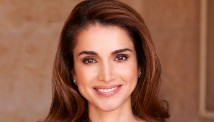
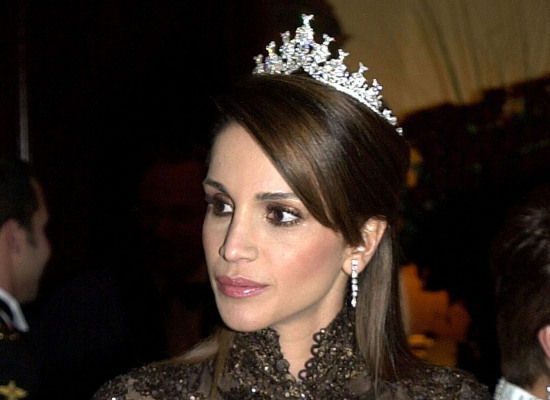
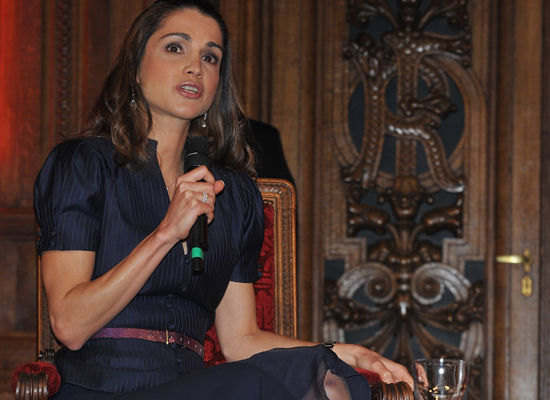
Rania Al Abdullah is the Queen of Jordan as the wife of King Abdullah II.

Vision-
Born: August 31, 1970 (age 42), Kuwait City, Kuwait
Height: 1.67 m
Full name: Rania Al Abdullah
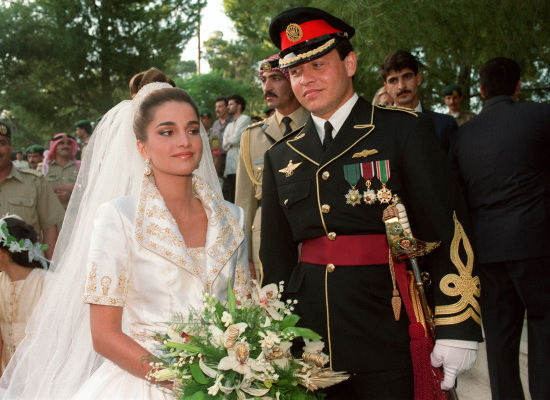
Spouse: Abdullah II of Jordan (m. 1993)
Education: HEC University of Geneva (1995), American University in Cairo (1991), New English School
Children: Hussein bin Al Abdullah, Crown Prince of Jordan,
bio-Her Majesty Queen Rania Al Abdullah is a mother, a wife, a boss, an advocate, and a humanitarian.
She once said, “I just wake up and feel like a regular person. At the end of the day you are living your life for the people that you represent. It’s an honour and a privilege to have that chance to make a difference – a qualitative difference in people’s lives – and it’s my responsibility to make the most out of that opportunity.”
For that reason, Queen Rania spends much of her time listening to and talking with the people of Jordan, to learn from them the best way to improve their livelihoods and Jordan’s prospects.
Queen Rania spearheads efforts in Jordan to adopt a holistic approach to national education, encouraging agencies and organizations to work on classroom quality, teaching standards, computer access, family involvement, community investment, and health awareness. Through initiatives, like Madrasati and the Teachers Academy, Queen Rania is helping Jordan’s children get the best start in life by repairing and revamping local schools, while inspiring teachers to be their best. She believes that the power of partnerships between the public, private, and non-profit sectors is a source of great potential for change in Jordan’s education system.
The Jordan River Foundation (JRF) is Queen Rania’s NGO that gives a helping hand to the disadvantaged in Jordan. For over ten years it has provided families with skills and knowledge to work themselves out of poverty. Today, it partners with the private sector and entire communities to bring resources, energy, and change to the lives of vulnerable citizens, empowering and inspiring them to believe they can make a difference for themselves and their loved ones. JRF is also recognized as a leader in the region for its achievements in protecting children. From rescuing abused children to healing whole families, JRF is now a centre of excellence, sharing its knowledge and know-how with others in and outside of the country.
Abroad, Queen Rania works for greater global action on access to quality education, and in her capacity as Eminent Advocate for UNICEF and Honorary Chairperson for UNGEI, she campaigns on behalf of children in need. She also participates in international gatherings, such as the Clinton Global Initiative and the World Economic Forum, of which she is a Board Member. As an Arab, Muslim woman, Queen Rania is committed to reconciling people of different faiths and cultures by encouraging cross-cultural dialogue, particularly amongst young people.
Her Majesty is author of the New York Times Best Seller, ‘The Sandwich Swap’, a children’s story about two young girls, Lily and Salma, who learn the value of diversity by exchanging food at school. Queen Rania is also the author of two other stories, ‘The King’s Gift’ and ‘Eternal Beauty’.
A keen runner, and seeker of good jogging tunes, Queen Rania enjoys spending time with her family and friends in Aqaba, where she can relax and get into a great book. She also makes a mean chocolate chip cookie.
Her Majesty is married to King Abdullah II ibn Al Hussein of Jordan, they have 4 children: Prince Hussein, Princess Iman, Princess Salma, and Prince Hashem.
|
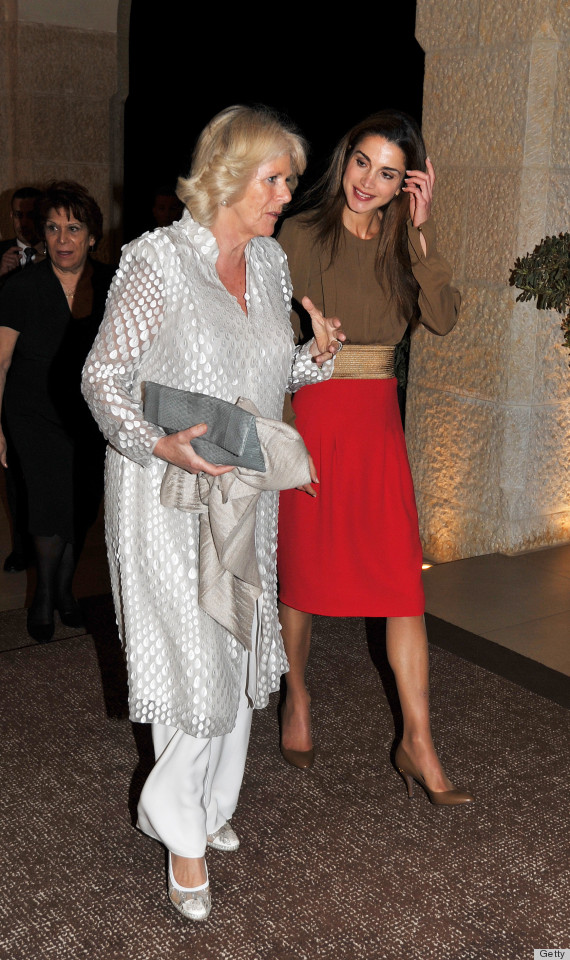
Queen Rania Looks Lovely
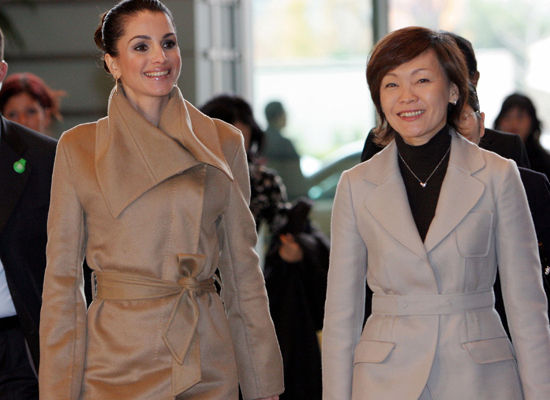
We get lots of quality British royal time, but what about the chic queens and princesses abroad? Thankfully Queen Rania is out and about these days, spending time with the Duchess of Cornwall in Jordan.
A queen's message to girls
Dear Girls of the World,
Some of you will be familiar with the childhood rhyme, "What are little girls made of? Sugar and spice and all things nice, that's what little girls are made of."
Marketing and stereotyping combine to have us believe that you're also made of pink dresses, pigtails, dolls, ringlets, ribbons, bows and tiaras. That you like cupcakes. That all you will want to be are wives and mothers. That you're more "inclined" to the arts and "better suited" to caring professions like teaching and nursing.
Queen Rania of Jordan
And, maybe, that's true for some. But my daughter Salma teaches me every day that there's so much more to you -- and for you.
Salma is 13, and I can count, on one hand (in fact, on one finger!), the occasions she's worn a dress -- and they've never been pink! Dolls always stayed on the shelf. She's happiest dribbling a soccer ball past her brothers and scoring goals or building model airplanes with her father. She dreams of being an engineer. That's my Salma; that's why I love her.
So, when I think about girls rising, I think of girls like her and her sister, Iman. I think of the millions of courageous girls all over the Arab world and beyond who, every day, summon inner strength, surmount barriers and make a difference in their communities.
Let me tell you about 16-year-old Wafa Al-Rimi.
Some days in Yemen, there's less than one hour of electricity, so studying is tough.
"We were tired of darkness," Wafa said in an interview.
Rather than accept defeat, though, she built foundations under her dreams. With help from business mentors, she formed an all-female company that created solar-powered lights. They won INJAZ Al-Arab's Best Company of the Year in November.
Wafa and her friends are part of a new generation of independent-thinking Middle Eastern girls: torch-bearers and trail-blazers.
Today, almost as many girls as boys attend primary and secondary school. In the majority of Arab countries where there's data, women outnumber men at university, and more women than men study science.
I see and I hear that determination to succeed every day in Jordan.
Recently, I visited a girls' school in the south of Jordan where 12-year-old Noor told me about her grandmother, a famous storyteller who narrated other people's stories. Noor was proud of her "teta," but she had her own dream.
"I want to be mayor," she said. "I want to build a library full of books; I want to build a park so that children can play safely."
Noor wanted to write her own story. I knew then that she, and girls like her, would write a new chapter for our region.
It won't be easy. We have a long way to go. Increases in girls' attendance at school and university are not yet reflected in politics, the job market or society's mindsets. And there are still 5 million girls out of primary and secondary school across the Arab world.
But as the political, social and economic plates shift and settle around our region, there's never been a better time for girls to rise up and share their talents with society. And, girls! Society has never needed you more.
We know that in every country around the world, healthy, educated girls can play a crucial role in stabilizing societies, resolving conflicts, bolstering democracies, strengthening economies and nurturing healthy and educated children.
But they can't do it alone.
Role models can inspire. Campaigns can motivate. But if we want all girls everywhere to rise up, then we must find them, befriend them and support them.
That means going outside our comfort zones. Maybe they're recovering from civil war in Sierra Leone, like Mariama -- now educated and a popular radio DJ. Maybe they're trapped in servitude in Nepal, like Suma -- now an activist working to free others. Maybe they're living in slums in India, like Ruksana -- now strong and in school.
And it means using our voices to speak up for those who cannot yet be heard. Lobbying for girl-friendly policies. Working with governments, non-governmental organizations, U.N. agencies and the private sector to create momentum for change.
Will it be easy? No.
Will it be as hard as studying in the dark or sleeping on a pavement? Enduring slavery or rebuilding a life after war? Going to school hungry and still achieving good grades? Certainly not.
And if we falter in our resolve, let's remember the strength and dignity of Wafa, Noor, Mariama, Suma, Ruksana and girls everywhere who, every day, fight for their right to education and opportunity.
If one girl with courage is a revolution, imagine what feats we can achieve together.
-- Her Majesty Queen Rania Al Abdullah
Vision-
Education = Opportunity.
The opportunity to work. The opportunity to escape poverty. The opportunity to live healthily. The opportunity to live confidently. The opportunity to hope.
I believe you deserve an education.
Whoever you are.
It’s your right.
Whoever you are.
It’s your right.
You deserve the chance to make the most of this brief glimpse we call existence. To be all you can be. To help those dear to you. To re-imagine the parameters of possibility.
Because education is transformative.
It can rescue a girl from the burdens of adulthood: early marriage and premature pregnancy.
It can empower a woman to take control of her life: mind, body, and soul.
It can defeat disease and temper intolerance: a shield for both our health and our humanity.
It can empower a woman to take control of her life: mind, body, and soul.
It can defeat disease and temper intolerance: a shield for both our health and our humanity.
Education is a Titan.
Whole communities and countries lifted from the quicksands of destitution to the plains of progress.
And the power of education lies not in the pages of textbooks, or the recital of facts and figures.
It resides in the mind of a child who is taught how to think. How to learn. How to navigate the world, avoid whirlpools, climb mountains.
It resides in the mind of a child who is taught how to think. How to learn. How to navigate the world, avoid whirlpools, climb mountains.
Education isn’t a line I’m spinning.
It’s a lifeline that’s saving.
Saving families. Saving futures
It’s a lifeline that’s saving.
Saving families. Saving futures

No comments:
Post a Comment